
Adaptive nozzle for 3D printing of composite materials
Designed to enhance the manufacturing of complex composite parts.
QUOTE No: TEC1104679
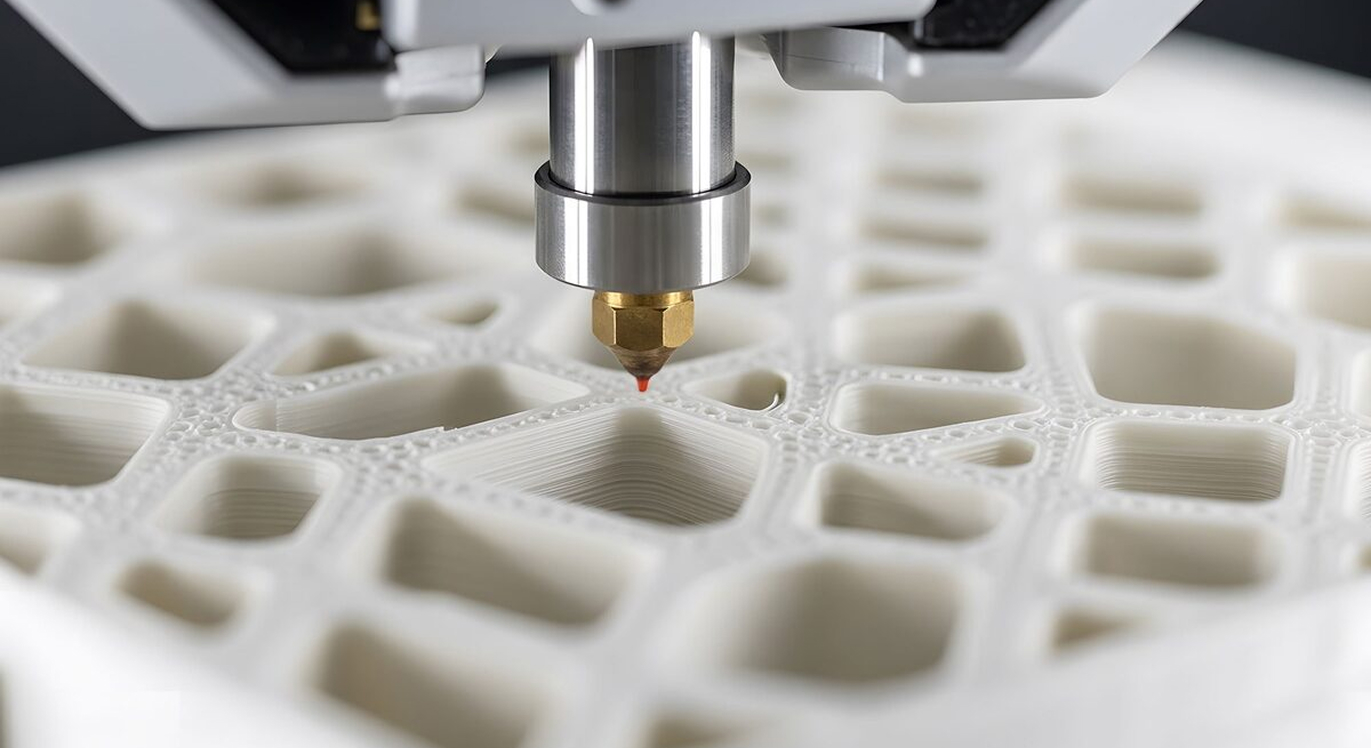
This technology tailors the cross-section of carbon fibre composites during 3D printing, ensuring optimal structure and strength whether crafting straight or curved rasters.
At a glance
Application
- 3D printing
- Automated Fibre Placement (AFP)
- Composite manufacturing
Development status
Undergoing validation
IP Status
PCT application has been filed
Commercial offerings
Licensing or co-development/collaborative research
Application
- 3D printing
- Automated Fibre Placement (AFP)
- Composite manufacturing
Development status
Undergoing validation
IP Status
PCT application has been filed
Commercial offerings
Licensing or co-development/collaborative research
Opportunity
The Edinburgh Adaptive Nozzle introduces a major advancement in 3D printing with its ability to dynamically alter the cross-section of continuous carbon fibre (CCF) composites from rectangular to round during printing.
This innovation addresses the limitations of traditional fixed-nozzle printers that struggle with different raster shapes, leading to disruptions or compromised fibre alignment. By seamlessly switching feedstock shapes in situ, this technology enhances structural integrity and eliminates the need for manual feedstock changes, offering superior efficiency and stronger, more reliable composite structures.
This makes it a superior choice for industries seeking precise and versatile manufacturing solutions.
Technology
Our University of Edinburgh researchers have invented a new adaptive nozzle technology that surmounts the limitations inherent in conventional 3D printing approaches, particularly when dealing with AFP/ATP-graded CCF-PEEK materials. Traditional methods typically require tedious, ex-situ switching between rectangular tapes for straight rasters and circular filaments for curved rasters to optimally print parts with varied geometries. This not only interrupts the printing process, risking the continuity and alignment of carbon fibres, but complicates the production cycle and can affect the structural integrity and performance of the finished parts.
The innovative design of our adaptive nozzle allows for in-situ transformation of feedstock from tape to filament and vice versa, directly responding to the geometric demands of the print in real-time. This seamless transition dramatically improves fibre alignment and mitigates misalignment in both curved and straight rasters, enhancing the mechanical properties such as tensile and compression strengths of the 3D printed objects.
Moreover, the adaptive nozzle can switch modes without pausing the printing process, thus eliminating interruptions and promoting efficiency. This capability makes it especially suited for manufacturing complex parts that contain a mix of geometries, ultimately transforming complex composite manufacturing by enabling more intricate designs and superior structural qualities without the drawbacks of traditional fixed-feedstock systems.
Benefits
- Adaptive nozzle
- Use in 3D printing and Automated Fibre Placement (AFP)
- Enhances complex composite manufacturing by enabling the high-throughput production of superior, custom-designed composite geometries
- In situ transformation of tape to filament results in improved fibre alignment, without the need for interruption during 3D printing process
- Highly suitable for intricate and complex geometries, requiring a combination of straight and curved rasters.
Interested in learning more?
Speak to our expert
Nikos Christogiannis
Technology Transfer Executive
Nikos Christogiannis bio
Nikos Christogiannis
Technology Transfer Executive
