
Power of Innovation
AI and high street eye tests could reveal dementia risk
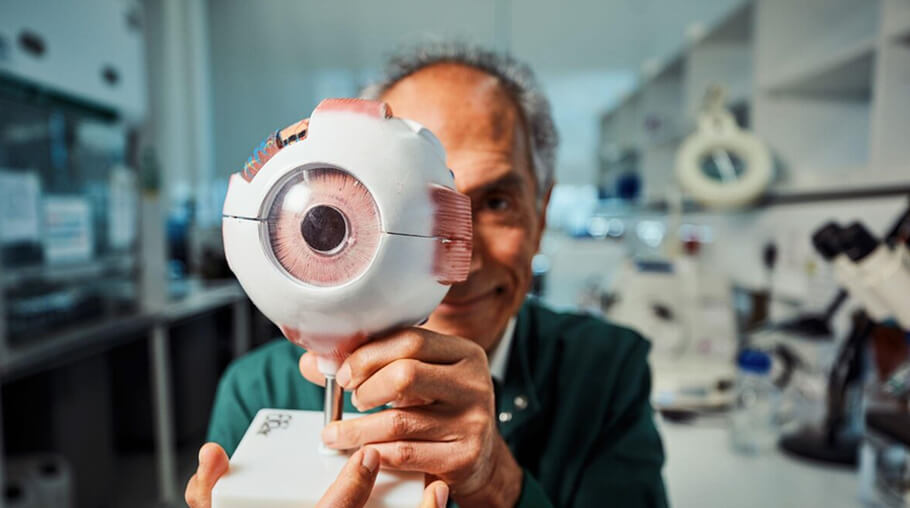
The scientists are using artificial intelligence and machine learning to analyse the image data, linked to relevant patient data on demographics, treatment history and pre-existing conditions.
This data is anonymised and patients can’t be identified, but it allows researchers to find patterns that could indicate a person’s risk of developing dementia. Retired mechanical engineer, David Steele, 65, whose mother had Alzheimer’s, said predictive software like this could have saved his family ten years of heartache and struggle.
“My mum was initially diagnosed with dry macular degeneration, but this masked the underlying issue that we now know to be cerebral blindness linked to Alzheimer’s.
If we had known, then we would have been able to access help.” Identifying people at risk of dementia could also accelerate the development of new treatments.
The data is held securely in the Scottish National Safe Haven, hosted by the Edinburgh International Data Facility through EPCC at the University of Edinburgh. The project came out of a partnership called NEURii, between global pharmaceutical, philanthropic, health data and medical research organisations and the University of Edinburgh. The collaboration, facilitated by Edinburgh Innovations, aimed to transform care for people living with dementia.
Facts and figures
£113m
secured in combined industrial and translational research awards

£15m
processed for consultancy projects
649
organisations collaborated with
Building cyclone resistant homes

The School of Engineering’s Dr Thomas Reynolds, Dr Yuner Huang and Dr Chris Beckett are working with the Red Cross and local people to test construction techniques and materials that will build more resilient homes. Working alongside researchers from the universities of Liverpool and Antananarivo, they developed a consistent process for making building components and a portable structural testing rig. The team worked with the Red Cross to train and enable local operatives to perform structural tests.
They used software developed at the University of Edinburgh to give an immediate visual representation of results, demonstrating examples to the – sometimes large – crowds of local people watching.
Back in Edinburgh, the team analysed the data and made recommendations about how guidelines and experiments should be adapted for future fieldwork and how the rig can be adapted to test other components used in traditional building techniques, such as clay bricks.
The project was initially funded by the University’s EPSRC IAA programme and has been supported by Edinburgh Innovations.
Data to tackle liver disease
Containing data from 940 patients in Scotland, SteatoSITE combines tissue-derived metrics and clinical data such as pathology scores, hepatic RNA sequencing, and routine health data from electronic patient records. It was co-created with funding from Innovate UK by the University of Edinburgh and the Precision Medicine Scotland Innovation Centre in Glasgow, using tissue from the NHS Biorepository Network and data from 12 of the 14 Scottish National Health Service (NHS) boards through the Scottish Safe Haven Network.
Using the data storage and computational infrastructure provided by EPCC Safe Haven Services, SteatoSITE enables researchers to collaborate with industry to develop impactful tools for global public health.
New £9m virtual production studios for Scotland’s creative industries

The CoSTAR Realtime Lab opened its first dedicated virtual production studio at Chroma Developments’ Water’s Edge in Dundee in February, marking the start of operations for a major infrastructure project that will provide a significant boost to Scotland’s screen industries.
Researchers are collaborating with industry partners to enhance production pipelines through advancements in 3D environments, video processing, performance and motion capture, facial animation, automated speech, and hyper-realistic digital film sets.
Led by Abertay University, the Lab is operated in partnership with the University of Edinburgh, supported by Edinburgh Innovations, with CodeBase, Interface and Chroma Developments.
It represents the largest investment in creative industries R&D to date, with a £75.6m grant awarded by the UKRI Infrastructure Fund and delivered by the Arts and Humanities Research Council.
1st
in the world for industry, innovation and infrastructure
THE Impact Rankings 2025

C-Loop engineering biology hub to convert industrial waste into valuable chemicals
By engineering microrganisms, the Carbon-Loop Sustainable Biomanufacturing Hub (C-Loop) aims to make the manufacturing of everyday products – more than 90 per cent of which are manufactured from fossil fuels using unsustainable chemical processes – cleaner and part of a circular economy.
The new £14m hub will also establish the UK’s first BioFactory, a dedicated platform for waste analysis, sustainability evaluation and scale-up that will cut emissions, reduce landfill and help to build a fossil-free manufacturing base.
It will be led by Professor Stephen Wallace, UKRI Future Leaders Fellow and Chair of Chemical Biotechnology from the University of Edinburgh, in partnership with the Universities of Manchester, Nottingham and Surrey, University College London and Imperial College London.
“Amid a growing population, diminishing natural resources, and a changing climate, there is now an urgent environmental, industrial and political imperative to rapidly harness engineering biology technologies to defossilise manufacturing and accelerate the UK’s path to net zero.”
Professor Wallace
Director of C-Loop
Supported by Edinburgh Innovations, more than 40 industry partners are involved in the hub. Dr Andrea Taylor, CEO of Edinburgh Innovations, said: “In 2023, the UK Government identified engineering biology as one of its five priority areas, and it’s fantastic to see investment into this field: one that offers so much promise for sustainable industry, and an area where the UK can lead globally
Microbes transform plastic waste into paracetamol
In findings published in Nature Chemistry in June, the new method, using engineering biology techniques, produced virtually no carbon emissions. The team, also led by Professor Stephen Wallace, of the University’s School of Biological Sciences, used genetically reprogrammed E. coli, a harmless bacterium, to transform a molecule derived from polyethylene terephthalate (PET) plastic, known as terephthalic acid, into the active ingredient of paracetamol.
Supported by Edinburgh Innovations, he is now in discussions with several pharmaceutical companies interested in manufacture.
